
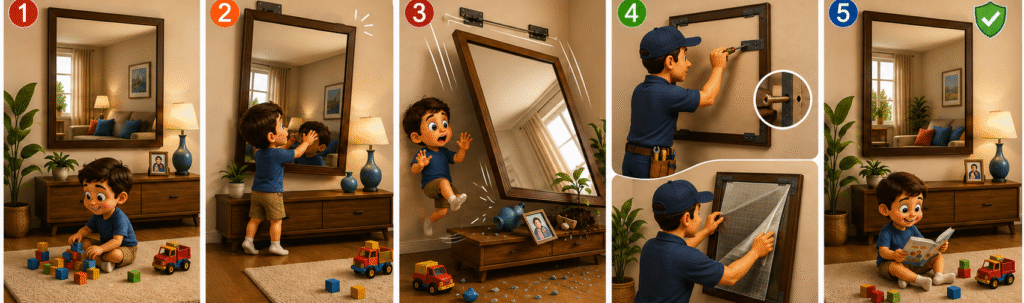
Mirrors make our homes and workplaces brighter, larger, and more attractive. However, a heavy mirror that is not properly secured can become a serious safety hazard.
Whether mounted in a bedroom, bathroom, hallway, gym, salon, hotel, office, school, church, or hospital, an unsecured mirror can fall unexpectedly, causing severe injuries or property damage.
Children are particularly at risk because they may touch, lean against, or accidentally pull on mirrors while playing. Even adults can be injured if a poorly installed mirror comes loose from the wall.
Fortunately, these accidents are highly preventable. Proper installation, suitable wall anchors, regular inspections, and shatter-resistant safety film can significantly improve safety.
Whether you’re in Nairobi, Mombasa, Kisumu, Nakuru, Eldoret, Arusha, Kampala, Kigali, or anywhere in East Africa, securing heavy mirrors should be part of every building’s safety plan.
Why Are Heavy Mirrors Dangerous?
Large mirrors are often made from thick sheets of glass and can weigh many kilograms. If they are attached using the wrong hardware—or installed on weak walls—they may loosen over time.
Common causes include:
- Incorrect installation
- Poor-quality wall anchors
- Loose screws
- Weak plasterboard or drywall fixings
- Corroded fittings
- Wall movement
- Children pulling or climbing
- Doors repeatedly slamming nearby
- Accidental impacts
When a mirror falls, the weight of the glass and the sharp fragments can cause devastating injuries.
Where Should Mirrors Be Properly Secured?
Heavy mirrors should always be securely fixed in:
Homes
- Bedrooms
- Living rooms
- Bathrooms
- Hallways
- Dressing areas
- Walk-in closets
Schools
- Washrooms
- Changing rooms
- Dance studios
- Staff rooms
Hospitals & Clinics
- Patient bathrooms
- Consultation rooms
- Staff changing areas
Hotels
- Guest rooms
- Bathrooms
- Reception areas
- Fitness centres
Salons & Barber Shops
- Styling stations
- Reception areas
- Makeup rooms
Offices
- Washrooms
- Boardrooms
- Reception areas
- Gyms
Churches & Community Centres
- Washrooms
- Choir rooms
- Meeting rooms
Injuries Caused by Falling Mirrors
A falling mirror can cause:
- Deep cuts
- Severe bleeding
- Head injuries
- Eye injuries
- Broken bones
- Facial injuries
- Permanent scarring
- Tendon damage
- Fatal injuries in severe cases
Children and older adults are especially vulnerable.
Warning Signs Your Mirror May Not Be Safe
Your mirror may require immediate attention if:
✔ It moves when touched.
✔ There are loose mounting brackets.
✔ Screws are pulling away from the wall.
✔ Cracks appear around the fixing points.
✔ Adhesive alone is holding the mirror.
✔ Rust is visible on mounting hardware.
✔ The mirror makes unusual noises when doors close.
How to Prevent Mirror Accidents
1. Install Mirrors Using Proper Wall Anchors
Heavy mirrors should always be secured using wall anchors, brackets, or fixings that are suitable for both the weight of the mirror and the type of wall.
Whenever possible, fasten mirrors into structural supports such as wall studs or solid masonry.
Never rely on small picture hooks for heavy mirrors.
2. Use High-Quality Mirror Mounting Brackets
Purpose-made mirror brackets distribute the weight evenly and provide a much safer installation than improvised fittings.
Always follow the manufacturer’s installation instructions.
3. Apply Shatter-Resistant Safety Film
Installing shatter-resistant safety film helps hold broken glass together if a mirror breaks, reducing the risk of dangerous flying shards.
Important Disclaimer
Safety film does NOT prevent mirrors from breaking.
Its purpose is to help retain broken glass fragments after impact, reducing the likelihood of serious injuries.
4. Inspect Mirrors Regularly
At least twice a year, check:
- Mounting brackets
- Screws
- Wall anchors
- Cracks
- Corrosion
- Loose fittings
Repair any defects immediately.
5. Keep Furniture Away from Large Mirrors
Avoid placing beds, chairs, toy boxes, or climbing furniture directly beneath heavy mirrors.
This discourages children from climbing or pulling on them.
6. Teach Children Not to Play Near Mirrors
Explain that mirrors are not toys and should never be climbed on, pushed, or struck with objects.
Adult supervision remains essential for young children.
Recommended Safety Products
Heavy-Duty Wall Anchors
Designed to securely support heavy mirrors when installed correctly.
Mirror Mounting Brackets
Provide strong, stable support for wall-mounted mirrors.
Shatter-Resistant Safety Film
Helps hold broken mirror glass together if it breaks, reducing the risk of injury.
Wall Stud Finder
Helps identify suitable structural fixing points before installation.
Corner Protectors
Useful where mirrors are installed near low furniture or play areas.
Common Installation Mistakes
❌ Hanging heavy mirrors with ordinary picture hooks.
❌ Using wall plugs that are not rated for the mirror’s weight.
❌ Installing mirrors on damaged walls.
❌ Relying only on adhesive.
❌ Ignoring loose fixings.
❌ Failing to inspect mounting hardware over time.
Myths About Mirror Safety
Myth: Adhesive alone is enough to hold a heavy mirror.
Fact: Most heavy mirrors should also be mechanically secured using suitable mounting hardware.
Myth: If a mirror has been hanging for years, it must be safe.
Fact: Fixings can loosen, corrode, or weaken over time. Regular inspections are essential.
Myth: Safety film makes mirrors unbreakable.
Fact: Safety film does not stop the glass from breaking. It helps retain broken fragments and reduce injury risk.
Mirror Safety Checklist
Before leaving this page, check your property:
☐ Are all heavy mirrors securely mounted?
☐ Are proper wall anchors being used?
☐ Have the fixings been inspected recently?
☐ Is shatter-resistant safety film installed?
☐ Are children prevented from climbing near mirrors?
☐ Is the wall in good condition?
☐ Are loose mirrors repaired immediately?
If you answered No to any of these questions, your property may require additional safety improvements.
What Should You Do If a Mirror Falls?
If a mirror falls:
- Keep everyone away from broken glass.
- Check for injuries and call emergency medical services if needed.
- Do not allow children to walk through the area.
- Wear protective gloves when cleaning up broken glass.
- Place broken glass in a rigid container before disposal.
- Replace the mirror only after identifying and correcting the cause of the failure.
Frequently Asked Questions
Can I install a heavy mirror myself?
Small mirrors may be suitable for DIY installation, but large or heavy mirrors should be installed using the correct hardware. If you’re unsure, use a qualified installer.
Is safety film suitable for mirrors?
Yes. Safety film can help retain broken glass fragments if a mirror breaks. However, it does not prevent the mirror from breaking.
Should mirrors in schools and gyms be protected?
Absolutely. Areas with high foot traffic or children should have securely mounted mirrors, and safety film should be considered where appropriate.
How often should mirror fixings be inspected?
Inspect mirrors at least every six months, or sooner if you notice movement, loose fittings, or wall damage.
Request a Free Quote
Need help securing heavy mirrors in your home, office, school, hotel, salon, church, hospital, or commercial building?
We supply and install heavy-duty mirror mounting systems, wall anchors, shatter-resistant safety film, and other glass safety solutions across Kenya.
Click the button below to request a free quotation or send us a WhatsApp message. Our team will recommend the safest installation method for your project.
Download the Complete Child Safety Guide
Heavy mirrors are just one of many hidden hazards that can lead to preventable injuries.
Download our comprehensive Child Safety Guide to learn practical room-by-room safety measures that help protect children and create a safer home.